
Nobody publishes a Chattanooga price list for septic pumping by tank size, and the pages that claim to are content farms with numbers that contradict themselves. What does exist is a set of national cost surveys, one local company's published starting price, and a published Hamilton County fee schedule. Put together, they let you walk into a quote knowing roughly what a 1,000-gallon pump-out should cost, what the add-ons are, and which line items are government fees rather than contractor charges. Every figure below is an estimate, not a quote.
The price table
These are typical national ranges from Fixr (2025) and HomeAdvisor (2026) — estimates, not quotes. Your price depends on tank size, access and what the crew finds when the lid comes off.
| Item | Typical range |
|---|---|
| Septic tank pumping, by tank size: 750 / 1,000 / 1,250 / 1,500 gal | $175–$300 / $225–$400 / $300–$600 / $345–$600 |
| Pumping, national average | about $400 (typical $300–$600) |
| Extra for an unknown or buried lid (locating and digging) | varies; ask for a flat fee |
| Septic inspection: standard / with camera | $100–$200 / $250–$1,175 |
| Riser installation | $300–$600 |
| Lid replacement | $150–$500 |
| Baffle repair | $300–$900 |
| Effluent filter clean / replace | $100–$200 / $200–$300 |
| Pump repair / replacement | $250–$400 / $1,000+ |
| Drain field repair or replacement | $5,000–$12,000 (about $7,000 typical; up to $20,000) |
| Grease trap pumping | $200–$500 per visit |
| Hamilton County fees (government, not contractor) | repair permit $40; Inspection Letter $105; Recertification Letter $180; new-system permit $440 |
Local cross-check: one local company's published starting price, 2026, is pumping "from $250." That sits inside the Fixr band for a 1,000-gallon tank and a little above the 750-gallon band, which is what you would expect for a market where the lid often has to be found first.
Tank size is the biggest variable, and your bedroom count predicts it
Pumpers price by volume because a vacuum truck's time and disposal cost scale with gallons. Fixr's survey works out to roughly $0.30–$0.40 per gallon. Most homeowners have no idea what size tank is buried in the yard, but Tennessee's sizing rule gives a reliable guess. Rule 0400-48-01-.08 sets minimum septic tank capacity by bedrooms: two or fewer bedrooms, 750 gallons; three bedrooms, 900 gallons; four bedrooms, 1,000 gallons; and 250 more gallons for each additional bedroom. So a three-bedroom house in Hixson most likely has a 900- or 1,000-gallon tank and should land in the $225–$400 band; a five-bedroom house in Ooltewah with a 1,250-gallon tank sits in the $300–$600 band. The permit on file with Hamilton County Groundwater Protection will state the actual size.
Age matters too. Ooltewah's ZIP code (37363) has a median year built of 2003 and 57.1 percent of its housing built in 2000 or later (ACS 2024 5-year), which means a large share of the county's newest septic systems are reaching their first or second pump-out. A tank that has never been pumped in twenty years may carry a thicker sludge layer and take longer, which some companies price as a surcharge.
What pushes the price up
Finding and digging the lid
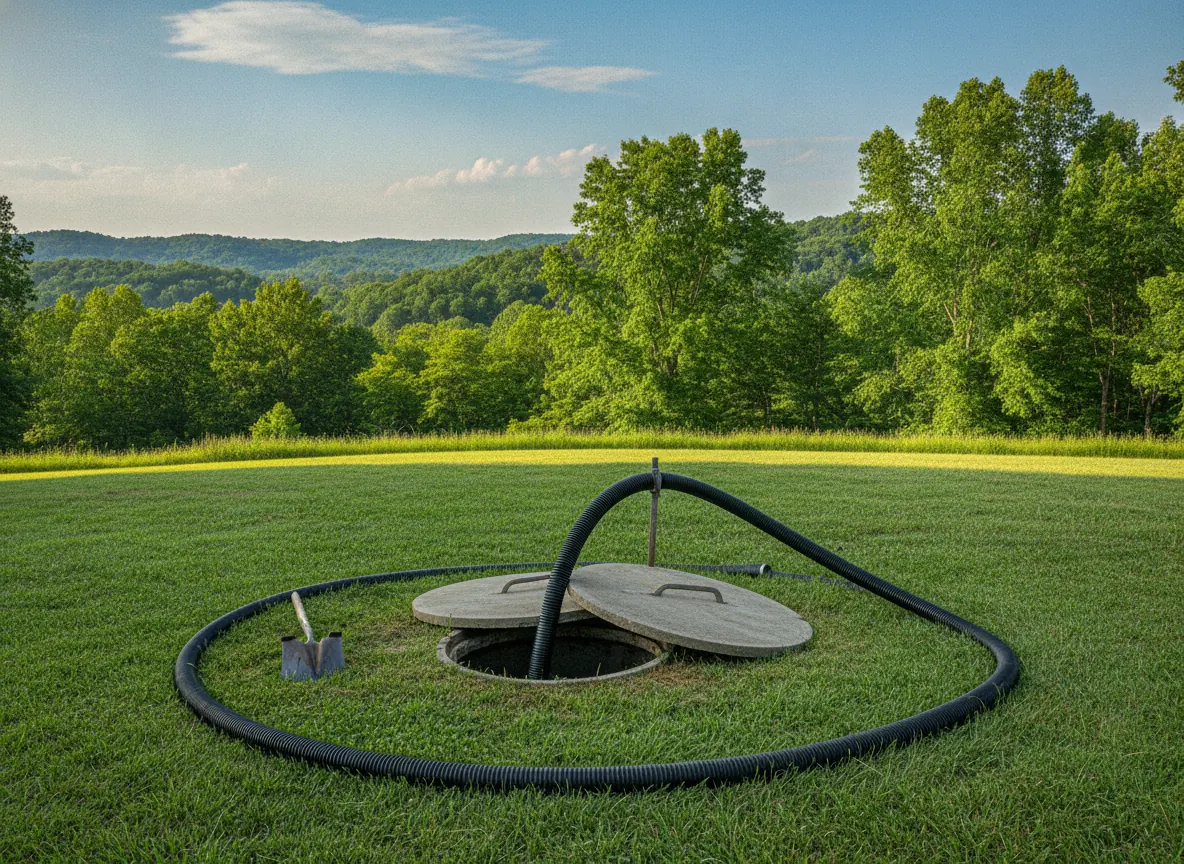
Fixr's $200 low-end figure assumes the lid is already uncovered. If the company has to probe for the tank, dig through 12 to 24 inches of Hamilton County clay and re-cover it, expect an added charge; ask for it as a flat fee before the shovel comes out. This is the single most common reason a quoted price and an invoice differ, and the permanent fix is a riser (see below).
Risers and lids
A riser brings the tank opening to grade so that every future pump-out skips the digging. Installed, the national range is $300–$600; a replacement lid runs $150–$500. Our post on septic tank risers and lids covers why Tennessee has no riser requirement and when one pays for itself.
Filter, baffles and pumps
Many tanks built since the 1990s have an effluent filter on the outlet. Cleaning it during a pump-out is typically $100–$200; replacing it, $200–$300. A cracked or missing baffle is $300–$900 to repair. Homes with a pump tank (common on sloped lots in Signal Mountain and anywhere a low-pressure-pipe or drip field was permitted) can face $250–$400 for a pump repair or $1,000 and up for a replacement. None of these are pumping; they are repairs that a permitted installer handles and the county may want a $40 repair permit for.
Access and distance
Vacuum trucks carry a finite length of hose. A tank far from where the truck can park, behind a fence, or down a steep drive may add time. Mention the layout when you ask for a quote.
Timing
Same-day, weekend or after-hours calls generally cost more than a scheduled visit; one national survey put emergency weekend pump-outs above $1,200. A company can usually come the same or next day if a truck is available, but that availability is never guaranteed. See emergency septic service for what to expect.
Disposal
Pumpers pay to get rid of what they haul. In Chattanooga, haulers discharging at the city's hauled-waste facility need a $100-per-vehicle annual permit, and the per-gallon tipping fee is not published; that cost is built into every quote.
Government fees are a separate line
Hamilton County Groundwater Protection charges fees that have nothing to do with the contractor's price: a repair permit is $40, an Inspection Letter is $105, a Recertification Letter is $180, and a new-system permit is $440. You will not see these on a routine pumping invoice, but you will meet them if a pump-out turns into a repair or if you are selling the house. In Bradley County the equivalent TDEC fees are different (an inspection of an existing system is $200 under Rule .21 and a repair permit has no fee). Ask any company to separate "our charge" from "county fee" on the estimate.
Pumping versus inspection
A pump-out is not an inspection, and an inspection is not a pump-out. A standard visual septic inspection runs $100–$200 nationally; adding a camera through the lines pushes it to $250–$1,175. Many companies will quote a combined pump-and-inspect visit, which is often the cheapest way to get both. If you need the inspection for a home sale, read selling a house on septic in Tennessee first, because the county's Inspection Letter is a separate government product from whatever the contractor writes up.
How often you will pay it
No Tennessee rule sets a pumping interval. EPA's guidance is that household tanks are "typically pumped every three to five years" and inspected at least every three years. At the national average of about $400 per visit, that is roughly $80 to $135 a year for the tank, which is cheaper than any drain field repair on the table above.
How to get an accurate quote
- Know (or estimate from bedrooms) your tank size, and whether a riser is already installed.
- Say when it was last pumped and whether you have had slow drains or wet spots.
- Ask for the digging charge as a flat fee and the disposal cost as included.
- Ask for the TDEC pumper permit number and the Hamilton County license; both lists are public, as our guide to who regulates septic in Hamilton County explains.
- Get the filter clean, any riser work and any repair quoted separately from the pump-out.
How this site fits in
Septic Pumping Chattanooga connects Chattanooga-area homeowners with independent local septic pumping, inspection and repair companies for free, no-obligation quotes. We do not set the prices above and we do not perform the work; the numbers are national estimates to help you judge a local quote. For the full breakdown see our septic pumping cost page, then request free quotes; we usually reply the same day.
Frequently asked questions
How much does it cost to pump a septic tank in Chattanooga?
Typical national ranges from Fixr (2025) are $175–$300 for a 750-gallon tank, $225–$400 for 1,000 gallons, $300–$600 for 1,250 gallons and $345–$600 for 1,500 gallons, with a national average of about $400. One local company publishes a starting price of $250 for 2026. Locating and digging a buried lid, filter cleaning and after-hours service add to the base. These are estimates, not quotes.
What size septic tank do I have?
Tennessee Rule 0400-48-01-.08 sizes tanks by bedrooms: 750 gallons for two or fewer, 900 for three, 1,000 for four, plus 250 gallons for each added bedroom. The permit on file with Hamilton County Groundwater Protection (or TDEC in Bradley County) states the actual size. If you cannot find it, tell the pumper your bedroom count and they will quote the matching band, adjusting once the lid is open.
Are Hamilton County septic fees included in the pumping price?
No. County fees are government charges, separate from the contractor's price: a repair permit is $40, an Inspection Letter is $105, a Recertification Letter is $180 and a new-system permit is $440. A routine pump-out involves none of them. They appear only if the visit turns into a permitted repair or if you need a county letter for a sale. Ask for them as a separate line on any estimate.